
Right now, someone is spending their Thursday afternoon copying records from a government website into a spreadsheet. They’ve done it every week for two years. It takes three hours. They hate it.
They would pay money to make it stop.
This is happening in every industry, in every city, in every corner of the economy. Valuable information exists — public, legal, accessible — but it’s scattered, unstructured, and painful to gather. The data is already there. It’s just waiting for someone to package it.
The Hidden Infrastructure of Manual Work
Most professionals don’t think of themselves as data gatherers. But look at how they actually spend their time.
Real estate investors pull foreclosure filings from county recorder sites. Recruiters scrape LinkedIn and job boards for leads. Sales teams monitor competitor pricing by clicking through websites. Compliance officers track regulatory changes across dozens of agencies. Journalists dig through court records for stories.
None of this is secret. It’s all public. But it’s distributed across hundreds of sources, each with its own interface, its own format, its own update schedule. So people do it manually, week after week, because no one has built anything better.
That manual work is a signal. It’s the market telling you exactly what it needs.
Public Data, Private Opportunity
Government websites are goldmines hiding in plain sight.
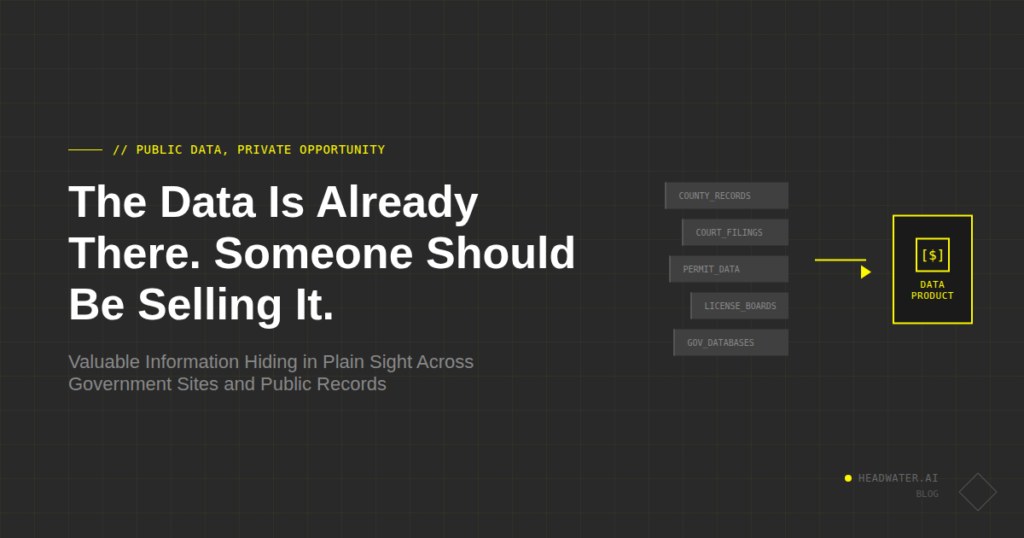
County recorders publish property transactions, liens, and foreclosures. Courts publish filings, judgments, and case statuses. Licensing boards publish who’s certified, who’s suspended, who’s newly registered. Permit offices publish what’s being built and where. SEC filings, patent applications, FCC licenses, DOT records — the list goes on.
This information is public by law. Anyone can access it. But “accessible” doesn’t mean “usable.”
Most government sites are built for compliance, not consumption. They’re slow, clunky, and impossible to search efficiently. They don’t offer APIs. They don’t send alerts. They update on their own schedule, not yours.
So the data sits there, technically available but practically locked away. The opportunity isn’t access — it’s packaging.
What Packaging Actually Means
Packaging is the work between raw data and useful product.
It means pulling from primary sources on a reliable schedule. It means normalizing formats so records from different counties or agencies look the same. It means enriching with context — appending related information, calculating derived fields, flagging what matters.
It means delivering in formats people actually use. A spreadsheet that opens in Excel. A feed that syncs to their CRM. An alert that hits their inbox when something relevant happens.
Packaging is unsexy. It’s ETL pipelines and cron jobs and field mapping. But it’s where all the value gets created.
Raw data is free or cheap. Packaged data is a product.
The Niches Are Everywhere
Every industry has its version of this problem.
Construction firms need permit data to find projects before they go to bid. Insurance adjusters need claims records to investigate fraud. Private equity firms need regulatory filings to track portfolio companies. Political campaigns need voter data merged with consumer profiles. Landlords need eviction records. Lenders need lien positions. Journalists need campaign finance disclosures.
Most of these niches are served poorly or not at all. The big data aggregators focus on volume, not specificity. They can’t optimize for every vertical. They can’t deliver the exact fields that matter to a particular workflow.
That leaves room for focused products. A feed that serves one industry, one geography, one use case — but serves it better than anyone else.
Why This Isn’t Being Done
If the opportunity is so obvious, why isn’t everyone doing it?
A few reasons.
First, it’s not glamorous. Building data products means wrangling government websites, handling edge cases, and doing maintenance work that nobody sees. It’s not a pitch deck that raises millions.
Second, it requires patience. You can’t validate a data product with a landing page and a waitlist. You need actual data, delivered reliably, before anyone will pay. The feedback loop is slower than SaaS.
Third, it’s fragmented. Every county, every state, every agency does things differently. There’s no universal schema. Scaling means solving the same problem fifty different ways.
But these barriers are features, not bugs. They’re what keep competition out. Anyone can have the idea. Few people will do the work.
The Simple Version
Here’s the opportunity in its simplest form:
Find people who manually gather public data on a regular basis. Build a system that does it for them. Charge a subscription.
That’s it.
The data is already there. The demand is already proven — people are spending hours on it every week. The only thing missing is someone willing to do the packaging.
It’s not complicated. It’s just work.
And that’s exactly why it’s wide open.
Headwater AI builds data products from public sources. We find the information people are gathering manually and turn it into automated feeds.