
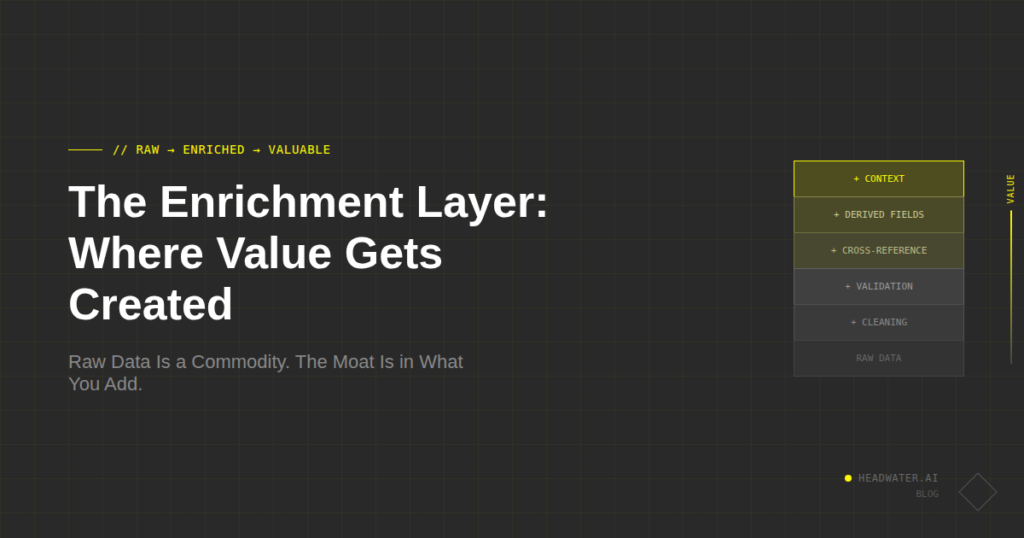
Anyone can scrape a website. Anyone can pull records from a public database. The raw data is out there, often free, waiting for someone to grab it.
So why would anyone pay for something they could technically get themselves?
Because raw data is useless. What people pay for is the work you do after extraction — the cleaning, the validation, the cross-referencing, the context. They pay for the enrichment layer.
That’s where the value gets created. And that’s where the moat gets built.
The Commodity Trap
There’s a temptation to think of data products as simple arbitrage. Find public information, package it nicely, sell it for more than it cost to gather. Easy margin.
But that logic has a problem: if all you’re doing is repackaging freely available data, you’re one competitor away from a price war. Someone else can build the same scraper, undercut your price, and commoditize your entire business.
Raw data is a commodity. It trends toward free.
The only way out of the commodity trap is to add something that isn’t easily replicated. Something that takes time, expertise, or proprietary assets to create. Something that makes your data more valuable than what someone could get by doing the work themselves.
That something is enrichment.
What Enrichment Actually Means
Enrichment is everything you do to raw data to make it more useful.
Cleaning is the baseline. Standardizing formats, fixing inconsistencies, removing duplicates, handling missing values. It’s tedious and invisible, but without it, downstream work falls apart. Most raw data sources are messier than people expect.
Validation is checking whether the data is accurate. Cross-referencing against other sources. Flagging records that don’t make sense. Building confidence that what you’re delivering reflects reality, not just what some government clerk typed into a form.
Cross-referencing is connecting data from multiple sources. A property record becomes more valuable when you append the owner’s mailing address from another database. A court filing becomes more actionable when you link it to the defendant’s business registration. Single-source data tells you what happened. Multi-source data tells you what to do about it.
Derived fields are calculations and inferences you add on top of raw data. A “days until auction” countdown calculated from filing dates. An “estimated equity” figure derived from loan balance and assessed value. A “priority score” that ranks records by likelihood of conversion. These fields don’t exist in the source — you create them.
Context is the interpretive layer. Notes explaining what a record type means. Flags indicating when something is unusual. Formatting that makes the data legible to someone who isn’t an expert in that domain. Context turns data into information.
Each of these layers adds value. And each makes your product harder to replicate.
The Moat Is in the Work
Moats in data businesses don’t come from access. They come from accumulation.
Every time you clean a new edge case, your data gets better. Every time you find a new source to cross-reference, your product gets richer. Every time you build a derived field that customers love, you’re adding something competitors would have to figure out themselves.
This work compounds.
A competitor starting from scratch has to solve all the same problems you did — the weird formatting from that one county, the records that don’t match, the calculations that took you three iterations to get right. They can copy your idea, but they can’t copy your accumulated decisions.
The moat isn’t a patent or a proprietary algorithm. It’s a thousand small improvements that add up to a product that’s just better than what anyone else offers.
Enrichment as a Pricing Lever
The more you enrich, the more you can charge.
Raw foreclosure filings? That’s a commodity — maybe worth $50/month if you’re saving someone time.
Foreclosure filings with owner mailing addresses, property details, equity estimates, and a priority score? That’s a tool. That’s worth $200, $300, or more.
The underlying data is the same. The difference is entirely in the enrichment layer.
This is why focused data products can charge premium prices even when the raw information is public. You’re not selling access to data. You’re selling the work that makes data useful.
And that work has real value.
Where to Focus
Not all enrichment is created equal. The best enrichment investments are:
High-impact for the customer. Adding owner mailing addresses to property records is high-impact because it directly enables the customer’s next action (sending mail). Adding lot square footage is nice-to-have but doesn’t change their workflow.
Hard to replicate. Cross-referencing three different county databases is harder to copy than adding a single calculated field. The more sources you integrate, the wider your moat.
Recurring. Enrichment that requires ongoing maintenance — keeping cross-references current, updating derived fields as conditions change — creates switching costs. Customers who’ve built workflows around your enriched data don’t want to start over.
Think about what would make your data dramatically more useful, not just slightly better. Then invest there.
The Simple Test
Here’s how to know if your enrichment layer is strong enough:
Ask yourself what would happen if a competitor launched tomorrow with the same raw data sources.
If the answer is “they’d have basically the same product,” you don’t have a moat. You’re selling a commodity.
If the answer is “they’d have the raw data, but they’d be missing all the work we’ve done to make it useful,” you’re in a better position. The more work they’d have to do to catch up, the wider your moat.
Raw data gets you in the game. Enrichment is how you stay in it.
Headwater AI builds enriched data products — not just raw information, but cleaned, validated, cross-referenced feeds that are ready to use.